Today was a good mail day, receiving a package from the folks at BladeOps. I got an IZULA fixed blade survival knife, in desert tan with kit.
The Izula has a skeletonized handle design that's just right for some knot work, and the optional 'kit' also includes several feet of paracord among the contents, which is just enough to make a lanyard, do a variety of handle wraps, or to coil some around the sheath.
You can find many different paracord wrapping tutorials on YouTube, and there are lots of photos online, where you can get an idea of how different paracord color combinations look with the knife.
I tried a few of the common type wraps/weaves, putting them on, then taking them off to try another, and know that I'll have to experiment some more to find one that I'll leave on it.
I even played around with adding a dreamcatcher with some bonded thread, and a four bight turks head knot with about 14 feet of 1.4mm cord.
In keeping with the recent 'cross knot' posts, here's a small cross knot paracord cross pendant/fob/zipper pull/lanyard, made with a couple of short leftover paracord strands.
I tied four knots for the vertical section, then tied one for the horizontal, pulled those strands through the back of one of the vertical section knots, and tied another knot. The end strands were trimmed and melted to finish, but sewing them in place with a needle and thread or using a drop of superglue would also work to secure the ends...
And another done with gutted paracord and shown on bead chain with dog tags. I used an 18" piece of paracord for the vertical section with four knots, and a 12" piece for the horizontal section with two knots. Those lengths allowed enough slack to tie the knots before tightening them and trimming the excess. Using some brush on superglue/krazy glue, that dries clear, to finish is optional...
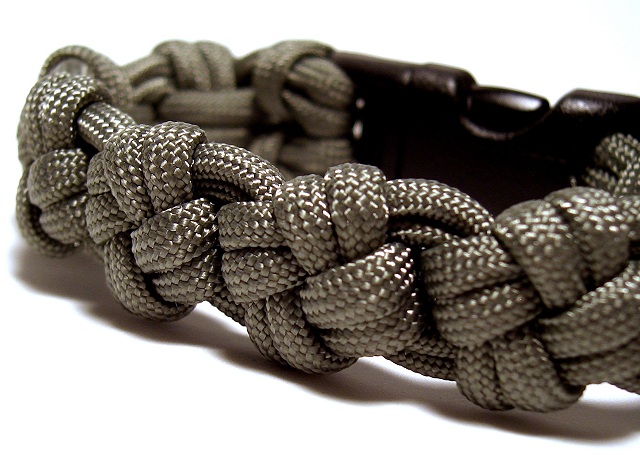
A couple of variations of tying a paracord bracelet and watchband, with using the cross knot, also known as knot #808 in The Ashley Book of Knots.
I doubled two pairs of strands for the bracelet, and alternated tying the knots with two pairs for the watchband...
Since both sides of the knot look different, you choose which you want facing out as you tie the knots. You could alternate them, or make them all the same on each side, as shown...
I used around 11 or 12 feet of paracord for tying each, with a 5/8" curved/contoured side release buckles, to fit my 8.5" wrist.
I tied this lanyard last year, with a leftover scrap of neon pink paracord, thus the black and white photos, lol, and stuck it in a drawer. At the time, I thought no one would be interested in it, but digging it back out, someone may find it useful and be able modify it to their own use. Perhaps running their belt though the loop, keeping the lanyard shortened for pocket carry, then extend the lanyard while still attached to the belt for use, with the swivel clip/snap hook allowing quick release of an item if preferred, etc...
Here's a YouTube video link for a short demonstration of the lanyard.
I may add a tutorial/walk through for making this particular lanyard later. But for a brief description: this one was made with about 4 feet of paracord, tying one Celtic Button Knot, making a loop, tying another Celtic Button Knot around the loop strand, then running the cord through the first Celtic Button Knot, tighten them up, and tying a Scaffold Knot(Multiple Overhand Sliding Knot) at the end of the cord to finish, where it can be attached directly to an item, or swivel clip, key ring, carabiner, and so on.
It may sound a little confusing, and hard for me to explain, but the Celtic Button Knots are tied on opposite sides of the loop, before the cords go through the center of them.
You can use other single strand knots, like the multiple overhand knot(example comes from Peter Owen's 'The Book of Decorative Knots'), tied loosely at one end of a length of cord, make a loop, tie another knot around the cord back toward the first knot, taking the cord through the first knot, tighten them up, finish with a scaffold knot, slip knot, etc.. to complete.
The one shown with the flashlight was done with about 4 feet of foliage green paracord, and the only problem with this knot, is that it's tightened around the sliding cord when pulled in either direction, so it can be harder to adjust compared with the Celtic Button knot.
A photo walk-through for tying this type of lanyard can be seen with photos I have stored on xanga(now gone, buggers).
Once you know how to tie the Celtic Button Knotand the Scaffold/Multiple Overhand Sliding Knot, you can follow this sequence of photos to tie the lanyard. I used a four foot length of paracord, but you can use more or less to make one to your own preferred longer or shorter length lanyard.
When in the shortened length, the Celtic Button Knot on the loop side can be moved along the length of cord that it's tied on, by moving slack from either side of the knot through it, and that will change the wrist loop size. Of course the simple design is open to variation, modification, and improvement, so experiment with it. I hope folks find it useful.
The way I sometimes tie a lanyard knot to finish at an attachment/swivel clip, also can slide, but I just haven't used them that way. With the cord looped around the attachment and then tying the lanyard knot with the cord in the center, the knot can be moved up/down the cord to the last knot tied, example seen here at the swivel clip. I just found the double loops of slack to be in the way, but someone might pursue trying something out with it...
The Horan Knives Sub-Q Tanto, mentioned in the previous blog post, got a sheath wrap with about 15 feet of some 2mm cord, in a two bight turks head knot(13L2B) with three passes.
The crossings of the knot show on both sides and I worked the cord where it's lined up down the edges of the sheath. It's worked tight, so it's not gonna slip.
The sheathed knife is about 7.25" long, so it's a good size for pocket carry. With the contours of the sheath, I may be able to tuck a small firesteel up under the wrap...
*Note: I added a short video of the knife and sheath wrap, and also was able to fit a small firesteel under the knot work, where it's a snug fit and won't come out on it's own.
I stopped by one of the local Army/Navy stores, that I hadn't been to in a while, and they've got lots of paracord choices than what they had before. At my last visit, over a year ago, I bought a couple of 100 ft hanks of paracord from their small selection of standard colors: black, tan, olive drab, white.
Now they offer many different colors in neons/camos/solids and have multiple brands to choose from: Atlanco, Atwood Rope Mfg, Rothco, all commercial type 550 paracord with 7 inner strands, and had a couple of larger 1000+ ft. sized spools. They had paracord bracelet kits, with about 10 ft of paracord and a 3/8" side release buckle with included instructions, various colors of 3/8" buckles in multi-packs, and some 5/8" black buckles, and handmade paracord duck call neck lanyards as well.
The DIY paracord using crowd has certainly gained in popularity over the last several years. It may be worth a trip to check your local Army/Navy store to see what they have in stock, if they're not too far away. The cost of gasoline is getting close to being higher than the shipping and handling charges when ordering online...
A few future knotting projects I have on the mental 'to do' list:
Add some paracord to a kydex sheath of the Horan Knives Sub-Q Tanto knife. Tim did a nice Japanese style wrap over nylon cord on the handle.
A blog reader, Ronnie H., sent me a large stone arrowhead that he made himself. An amazing piece of skilled craftsmanship(knapping) with very sharp edges. I was thinking of trying to mount it to a short section of 'arrow shaft' for display, in a small frame. I need to find a suitable sized piece of wood to use and maybe trying traditional arrow making tying methods, with artificial sinew or leather, or even playing around with using a turks head knot with small diameter nylon for attachment with some type of hitching over the shaft.
I've had an unused pool cue for several years, and have tried a few different knotted grips/hitchings for the handle, but haven't been satisfied with anything yet. I've left some green flat nylon cord wrapped around it, that I've tried a couple of open turks head knot patterns over, but have removed those and put it on a back burner until I get in a good knotting mood to get it just right...
I found a neat 'First Aid Aluminun Bottle' at Big Lots, which has a screw on compartment/mug with a small first aid kit included. It will eventually get some type of paracord knotted or hitched pouch/wrap to carry it. The only online source I could find for this bottle was on Amazon.
*Note: A white cross on a red field is recognized as the Flag of Switzerland, and a red cross on a white field is recognized as the symbol of the Red Cross. The International Organization of Standardization (ISO) sets a standard for the first aid symbol of being marked with a white cross on a green background, so that anyone requiring first aid would recognize the sign.
 Today was a good mail day, receiving a package from the folks at BladeOps. I got an IZULA fixed blade survival knife, in desert tan with kit.