Monday, May 31, 2010

Half hitched paracord water bottle sleeve...

Here's a half hitched aluminum water bottle sleeve, tied the same way I made the paracord pouches/can koozies, half hitching/needle hitching, but with the hitches spaced further apart. I used about 30 feet of paracord to cover the 750ml bottle and another foot or so for the cord lock and cinch cord finished with a Matthew Walker knot.

With the spaced out pattern of half hitches, the sleeve can get disorganized when removed from the bottle for cleaning, but it can be straightened back out after you put it back on.

The green water bottle came from the dollar store, and although it's not as nice as a SIGG, Klean Kanteen, or Nalgene, it didn't leak when I tested it and I'm satisfied with it.

Another blogger recently tied one and you can see it on their blog: Radiocake

Thursday, May 20, 2010

Chinese Crown Knot lanyard...

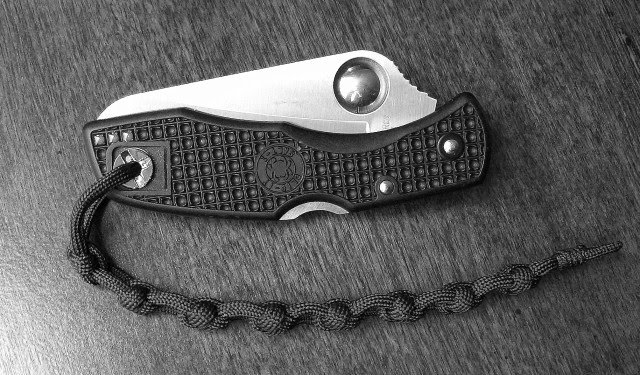
The knot used for this paracord lanyard/fob is a two strand lanyard knot, called the 'Chinese Crown Knot'. This is knot #808 in the ABoK(Ashley Book of Knots). The knot is also known as the Chinese cross, or the Rustler's or Friendship knot. Another knot book has it named as the Japanese Crown Knot or Japanese Success Knot.

I tied a series of eight of them with a three foot long length of paracord(inner strands intact), adding a little west country whipping on the end with some 0.9mm cord.

The knife shown is a Spyderco Salt I. In a couple of the photos, there's a ball bearing used to prop the knife up in back of the Spydie hole, just sayin' cause I know someone will ask. A carabiner or S-Biner could be used as an attachment, if clipped between the last couple of knots.

Sunday, May 16, 2010

Flat braided adjustable paracord watch strap...

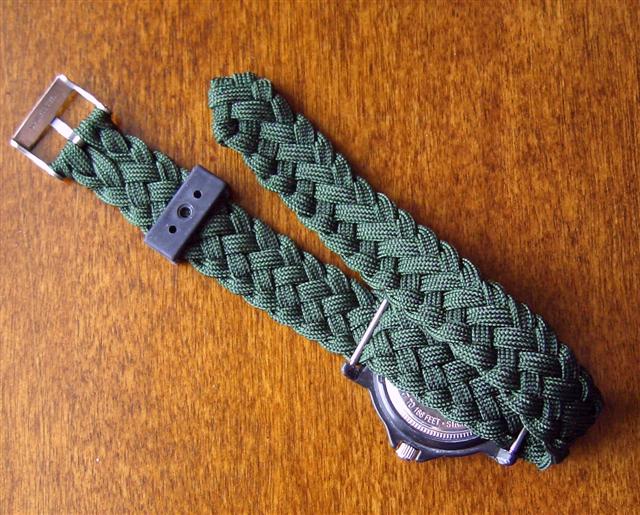
This flat braided paracord watchband/strap was made with three 36 inch gutted strands of paracord.

One strand is centered and cow hitched around the buckle/pin, and the other two strands centered and put over the pin within the first strand's cow hitch. There are then 6 strands to do the braiding, using the same method I did with the flat braided paracord belt.

Once I had the length I wanted, I turned the end strands back and tucked them in place, ran a needle and thread through to secure them, and trimmed off the excess.

I used the rubber strap keeper loop from the Swiss Army Renegade watch, that I've had for about 17 years, but I'll probably make a couple of keepers with the paracord to replace the borrowed one.

Thursday, May 13, 2010

Star knot and loop bracelet...

This is a type of knotted 'sailor's bracelet'.

I started with three strands of 1.4mm nylon cord, about 10 ft long each, which was more than I needed. I found the center of the cords, moved about an inch or so off to the side from that, and started a three strand crown sennit back towards the center for a couple of inches. I brought the ends together, making the loop, then continued with crown sennits with three paired strands, for the length I wanted. 

A six strand star knot was then tied at the end(here's another star knot tutorial). With a separate strand, I added a small turks head knot at the base of the loop.

Similar examples of these kind of bracelets can be seen on the Frayed Knot Arts website, in the 'Jewelry' section. It's a good site to explore and there are some various knotting tutorials linked there too. Here's a link for a photo of a nice one made by the late Bud Brewer.

Thursday, May 06, 2010

Adjustable Paracord Watchband...

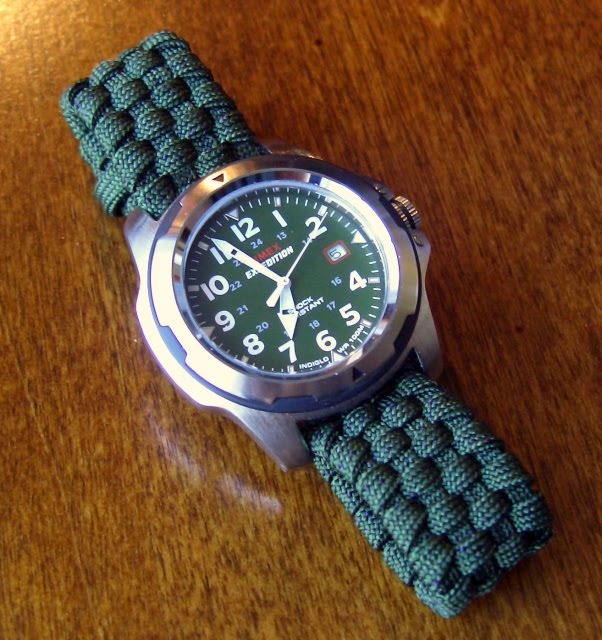
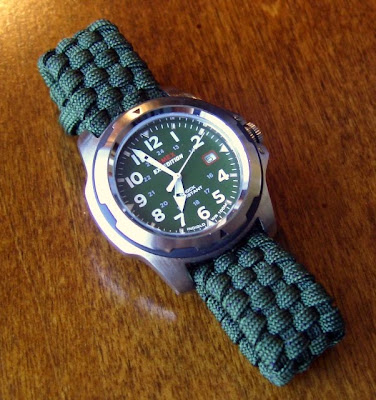
I made this adjustable paracord watchband with the similar weaving method to the paracord pouches/sheaths that I made, with the common basket weaving pattern.

This example is just a rough draft and can use some tweaking to improve it, but I still like the overall outcome.

I took the buckle off an old leather watchband and added four 1 ft long lengths of gutted paracord. I attached the paracord pieces to the buckle, with needle and thread, by sewing the end of each in a small loop around the buckle end.

I used a longer 7 or 8 ft long length of gutted paracord to do the over/under weaving around the four strands. I stopped when I ran out of paracord, then trimmed and tucked the ends. The ends can be sewn in place to further secure them. A short gutted length was used for the tucking band, made by tucking one end into itself and sewn together. It could be sewn in place on the watchband, but I left it free floating to slide where I needed it.


The band is not as long as I'd like it, so I'd use longer lengths of cord for further attempts. I didn't measure out the longer length before I started, so I haven't narrowed down how much is needed for a specific woven length. It's a tight fit for the paracord between the watch and pins. After I made the watchband, I removed the watch pins from the lugs, laid the band over the watch, and reinserted the pins to install the band. The watch stays in place on the band.


I would further secure the cord in the areas where the buckle pin comes through the paracord when sized around the wrist, to keep the cord from being pushed/pulled/stretched out around the pin. I need to get some heavy duty thread or possibly a kevlar sewing thread, which would be stronger and more durable than regular cotton/polyester thread.

My Timex Expedition Field Watch served guinea pig duty for this project, and a Suunto Clipper Compass(luminous/glow-in-the-dark) was also attached to the finished watchband.

And it can be worn alone, as an adjustable paracord bracelet...

A two-toned version, shown with green over tan paracord.