Friday, August 27, 2010

A Woven and Half-hitched Paracord Pouch...

A woven and half hitched paracord pouch, that I made to hold the 1/2 inch marbles I use for small monkey's fists and turks head knots. It also serves as a slingshot ammo pouch. About 30 feet of paracord was used, including the cinch cord/drawstring with cord lock.


*Photo collage instruction sheet added. A Perma-Lok Lacing Needle and hemostats/forceps(or thin needle nosed pliers) can come in handy with making this project.

*Added a video slide show for this project on YouTube.

Wednesday, August 25, 2010

Adding Paracord to Water Bottles and another Paracord Can Koozie...

Here are a couple of examples of adding paracord to water bottles.

A 25 foot length was used for the one in a 'whipping' pattern on the aluminum water bottle. And a 40 foot length was used in a woven pattern on the white stainless steel water bottle.

Both started of with coiling the cord around the bottles, with the starting end just held in place with a rubber band and later tucked to finish.

The 'whipping'(snaking) version, an example is seen in Geoffrey Budworth's 'The Complete Book of Knots', is easily zigzagged and looped around a couple of coils on each end of the paracord coiled wraps, and tucked to finish.

The woven version resembles 'grafting' type knot work, as seen in Stuart Grainger's 'Creative Ropecraft', but is instead a single length of cord. After coiling the cord around the bottle, one end is then worked in an over/under pattern, back up then down, all the way around the bottle. For this pattern, I went under three coils, over three coils, but like 'grafting', you can vary the pattern to your own tastes.

I used a Perma-Lok Jumbo Lacing Needle to feed the paracord over/under as I worked, as well as a pair of hemostats/forceps.

Here's a woven paracord can koozie, done with a 25 foot length of cord. The weaving is just like that done on the water bottle, but with the vertical over/under part done closer together for a tighter weave before changing to half hitching on the bottom.

I didn't have much paracord on hand to work with, so I reused some from the previous project. I would have made the can koozie a little bit taller and fully closed up the bottom, if I'd started with a 30 foot length, and a couple more feet for a cinch cord/drawstring with a cord lock for alternate use as a pouch. It still works alright as it is for holding a soda/beer can...

Thursday, August 12, 2010

Another paracord hatband on a boonie...

I've seen a few other boonie hats with cord in a crossing effect around the hat, but I don't think they started out with trying a two bight turks head knot, as I was intending, worked around the branch loops, on this tiger stripe camo boonie hat.

After tying/untying about a half dozen times, I ended up with just using the first couple of spiraling wraps around the hat, first in one direction, then the other, for the crossing effect. The remainder of the cord was worked around the hat a couple of times, underneath the crossings to finish.

I middled the 22 foot length of paracord when I started, to reduce the work of wrapping the cord, and so I only had to go around the hat about 4 times. If the cord is needed for some reason, it's not hard or time consuming to remove it, and it won't be all kinked up, like some other methods of tying.

The over hand knot, tucked through the hat's leather chin strap toggle, is where I started the hat band, and the center looped end of the cord, was tucked under the crossings, a little past the back center of the hat.

I added a YouTube video for this method of adding some paracord to a boonie hat, shown using a longer 30 foot length.


Thursday, August 05, 2010

'Dragon's Tongue' paracord bracelet...

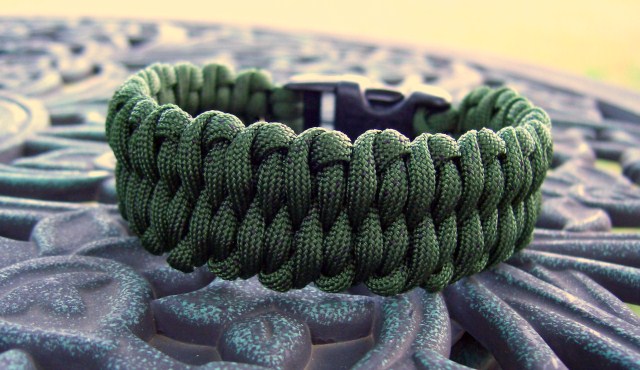
JD of TIAT recently made a YouTube video tutorial on 'How to tie a Dragon's Tongue'. I followed the tying method, but instead of two separate paracord strands, I used a single 12 foot long strand of paracord with a 5/8 inch curved side release buckle, to make a 9.5 inch long paracord bracelet.

Once I looped the center of the paracord onto one end of the buckle, measured for wrist length and looped onto the other buckle end, I had two working ends and two core strands to weave around, like shown in the video. The ends of the paracord were tucked into the weave on the underside of the bracelet with hemostats to finish. The video tutorial has the paracord stretched out, after weaving, for the 'lashing' tongue effect, but I left the cord bunched up to use more cord in the bracelet, and I prefer the wider effect of the weave.

The 9.5 inch finished length was actually a loose fit for my 8.5 inch wrist, so I'll probably untie it and adjust it to my wrist size instead of adding length, which is sometimes required with other paracord bracelet methods. A watch could be added midway through weaving for a wide watchband, or add something else like a compass, skull bead, etc... And it also works as a pet collar or you can adapt it for use as a lanyard or fob.

If you want to increase the amount of paracord used and don't mind a thicker sized paracord bracelet, you can run extra cord back and forth between the buckle ends a time or two more, for a four or six strand core which can be paired off and woven around, like the examples in this previous blog post.

*After untying/retying the bracelet to 8.5 inches long for a better fit, I still used all 12 feet of paracord that I started with, and tucked the excess under the weave along the inside of the bracelet.

A two-toned version for a family member that's an LSU fan, and has been undergoing cancer treatment.