Friday, September 20, 2019

Raising Cane...


The Jig Pro Shop sent me a couple of their Easy Assist Former Mandrels to test out back at the start of summer.  These are new Turk's head knot tying tools that don't require the user to have a lot of the knowledge of the ins and outs, overs and unders and rules with tying such puzzles of knot work, and be able to make some knots in different sizes.  I'm sure many would find tying them addictive and would want to learn more about the possibilities of where can they tie another one around something.

I'd not done much tying for a long spell with losing a consideral bit of my eyesight (legally blind), so they had just been sitting sat the back of my desk.
I tried tying a couple of smaller Turk's head knots on the mandrels, with paracord, after watching a YouTube video demonstrating their use.  They didn't arrive with any instructions, but they weren't hard for me to figure 'em out.

I wanted to challenge myself with the larger knot (a doubled 17 lead 5 bight knot, I think) and dark colored paracord, which is particularly difficult for me to see now.  It did take me a few attempts to get it right, at least I think it looks presentable on my walking cane, and there's plenty of room to add more.

I started with a much too long length of about 25 feet of black paracord (over guesstimating).  Tying the doubled knot on the mandrel only used around 15 feet, where I then removed it and slid it onto the cane for tightening and working the slack out.  I did use a bit of xtreme tape on the cane, before I started,  to keep the tightened paracord knot work from sliding/slipping on the slick cane surface when I was done.

Total time invested was a bunch of hours, although that includes having to untie and start over because of mistakes and errors that I was able to catch myself making.  Lots of talking to myself and trying to have patience, seeing the cord blurred and distorted while holding the work less than a foot away from my face...

The olive drab paracord gaucho and single strand star knots were tied on the cane years ago.


Tuesday, September 17, 2019

A two-strand four bight gaucho knot

I tied a longer loop paracord lanyard version of a two-strand four bight gaucho knot yesterday, and today tried tying another with a shorter loop directly to a pocket knife through the lanyard hole.

There's a video tutorial, by the Paracord Guild, that's easy to follow for tying this knot.


Being 'legally blind' doesn't mean you have to stop tangling up some cord. :)


Wednesday, September 11, 2019

Double Dragon Loop

The Double Dragon Loop is a fixed loop tied at the end of a string/cord/rope.  As an example I've tied a couple with attachments at the ends of a paracord lanyard.

I also tried doing a short 'howto' video tutorial on tying the loop.  As with the photos I take, I had to do multiple takes because I'm 'legally blind', and went with the one that looked the most usable to me.  :)


~ Victorinox Spartan SAK
~ Sanrenmu Urban Key Tool
~ EDC Gate Clip


Saturday, September 07, 2019

The Ashley Bend

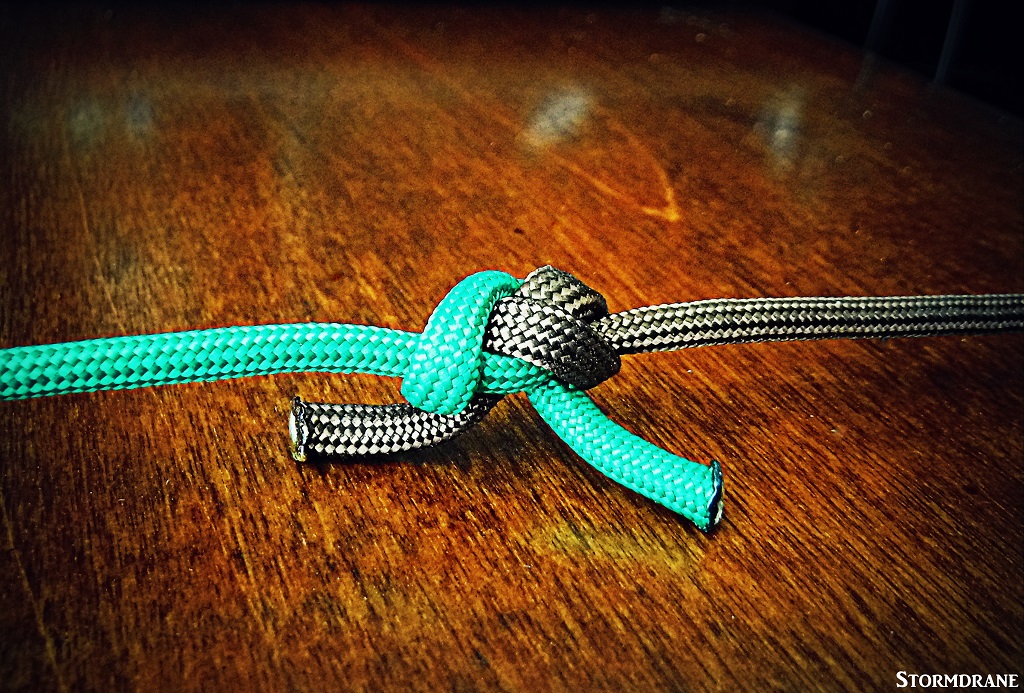
Here is yet another interlocking overhand knot for joining two strands of cord, like those of the previous few blog posts that I've done this week.

This time I've tied the Ashley Bend, ABOK # 1452, from the "The Ashley Book of Knots".

This bend can jam after being under tension, so having a marlinspike handy can help when untying those knots that don't want to come apart using just ones fingers/fingernails.

This example of the Ashley Bend is tied in green and brown paracord. 


Friday, September 06, 2019

The Alpine Buttefly Bend

This knot, shown tied in midnight navy and red paracord, is the Alpine Butterfly Bend.  A respectable and secure bend joining two cords that are similar in size.

The two cords can be easily untied after being under heavy strain compared to some other bends.


Thursday, September 05, 2019

The Hunter's Bend aka Rigger's Bend

As I continue fiddling with paracord, my camera and poor eyesight, I've tied another bend.

Today it's the Hunter's Bend, also known as the Rigger's Bend, a knot used to join two cords, certainly useful although it can jam under tension.


Wednesday, September 04, 2019

The Zeppelin Bend

This Wednesday morning had me playing around with two strands of paracord and the tying of overhand knot variations that are used to join two lengths of cord.  This example is the Zeppelin Bend.

The Zeppelin Bend is usually an easy one to untie after it's been tightened up, but not if it is still under tension.

There are a number of different bends, each with their pros and cons.  Some may have the tendency to jam, and if you want to easily separate the cords, that would not be desirable.  But, if you intend the cords to stay together forever and ever amen, then let them jam away...


Tuesday, September 03, 2019

What's up hitches...

I was doing some knotty web surfing and tied a couple of hitches that I saw in an IGKT forums thread.

A 1-Turn Boston Hitch pictured on the left, and an Alaskian Hitch on the right, in the orange paracord photo.

Original manuscript link for The Boston Hitch.