Friday, June 11, 2010

Cow hitched paracord water bottle sleeve...

I used about 45 feet of orange paracord, from Going Gear, to make this cow hitched paracord sleeve, to cover/carry/protect a 750ml(26oz) aluminum water bottle.

A couple of feet of paracord were used for the cinch cord with a lanyard knot and a cord lock, and about 43 feet of cord for the hitching to cover the bottle. A needle and some thread were used to further secure the cord at the start and finish of the knot work. More or less paracord may be used, depending on how tight/loose/close together the hitches are done. The cow hitching used a bit more cord than the half hitching did with another water bottle sleeve I tied.

A previous blog post has a photo collage, that I made, showing how to start the cow hitching. The last couple of photos in the collage show two different starting methods, one with the cord tied to itself to start for a permanent covering, and the other with a separate cinch cord and cord lock for a removable sleeve.

Thursday, June 03, 2010

Long 2 bight turks head knot on a cane...

I used about 20 feet each of black, olive drab, and tan paracord, to tie this long 2 bight turks head knot, with 59 leads, on a cane my dad got from the VA hospital. It's an early Father's Day present. I left the knot work spread out a bit since it's an adjustable height cane, and the button/slots are still accessible.

The 2 bight turks head knot is not hard to tie, but a long one can take a couple of hours or more to make the additional passes, keeping it straight, and working the slack out. The link shows a 2 bight turks head and how to increase it to a 4 bight knot.

A smaller turks head knot was tied over the start/finish of the 2 bight knot, at the cane handle, to help cover the trimmed ends of the spaced out knot.

Wednesday, June 02, 2010

T Handle Turks Head Knot...

I followed the instructions from Geoffrey Budworth's 'The Complete Book of Decorative Knots', to tie this modified 4 lead 5 bight T handle turks head knot on the handle of a walking cane. I've seen a few examples done on a ship's wheel/spoke and on a hammer.

I also used a new lacing needle when tying this turks head knot. My friend Manny made me a couple of them from hollow knitting needles. They're larger, but not threaded like the Perma Lok needles. After cutting them down to size, Manny formed a lip at the open end of the needles, so that they do a good job of holding on to the paracord after it's inserted.

For tying the turks head knot, I used some orange paracord that I bought during a visit to the Grand Opening party of the new Going Gear store in Smyrna, Georgia. Among all the neat gadgets, gear, flashlights, and gizmos, they also carry some 550 paracord that has 8 inner strands compared to the usual 7 strand core 550 paracord. I think the extra strand gives the paracord a bit more of a solid feel to it. The inner strands of paracord can be useful for those that want to remove and use them for other tasks if the need arises.

There's a tutorial for tying a T-shape turks head knot on the KHWW.net website.

Monday, May 31, 2010

Half hitched paracord water bottle sleeve...

Here's a half hitched aluminum water bottle sleeve, tied the same way I made the paracord pouches/can koozies, half hitching/needle hitching, but with the hitches spaced further apart. I used about 30 feet of paracord to cover the 750ml bottle and another foot or so for the cord lock and cinch cord finished with a Matthew Walker knot.

With the spaced out pattern of half hitches, the sleeve can get disorganized when removed from the bottle for cleaning, but it can be straightened back out after you put it back on.

The green water bottle came from the dollar store, and although it's not as nice as a SIGG, Klean Kanteen, or Nalgene, it didn't leak when I tested it and I'm satisfied with it.

Another blogger recently tied one and you can see it on their blog: Radiocake

Thursday, May 20, 2010

Chinese Crown Knot lanyard...

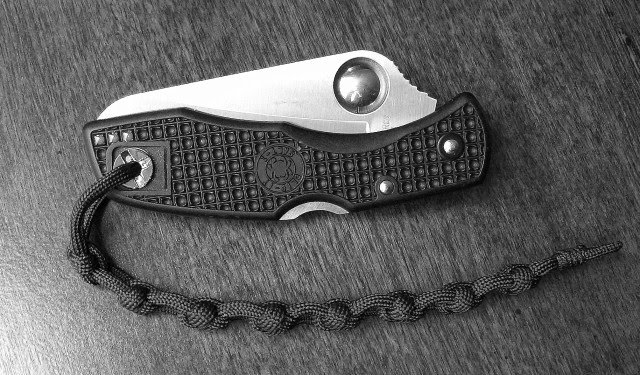
The knot used for this paracord lanyard/fob is a two strand lanyard knot, called the 'Chinese Crown Knot'. This is knot #808 in the ABoK(Ashley Book of Knots). The knot is also known as the Chinese cross, or the Rustler's or Friendship knot. Another knot book has it named as the Japanese Crown Knot or Japanese Success Knot.

I tied a series of eight of them with a three foot long length of paracord(inner strands intact), adding a little west country whipping on the end with some 0.9mm cord.

The knife shown is a Spyderco Salt I. In a couple of the photos, there's a ball bearing used to prop the knife up in back of the Spydie hole, just sayin' cause I know someone will ask. A carabiner or S-Biner could be used as an attachment, if clipped between the last couple of knots.

Sunday, May 16, 2010

Flat braided adjustable paracord watch strap...

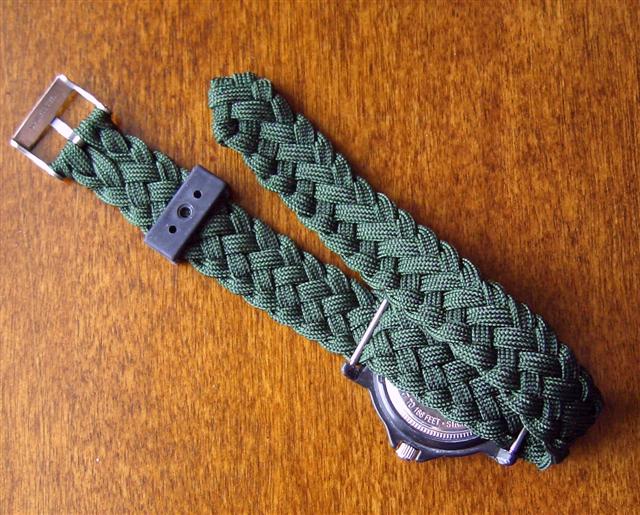
This flat braided paracord watchband/strap was made with three 36 inch gutted strands of paracord.

One strand is centered and cow hitched around the buckle/pin, and the other two strands centered and put over the pin within the first strand's cow hitch. There are then 6 strands to do the braiding, using the same method I did with the flat braided paracord belt.

Once I had the length I wanted, I turned the end strands back and tucked them in place, ran a needle and thread through to secure them, and trimmed off the excess.

I used the rubber strap keeper loop from the Swiss Army Renegade watch, that I've had for about 17 years, but I'll probably make a couple of keepers with the paracord to replace the borrowed one.

Thursday, May 13, 2010

Star knot and loop bracelet...

This is a type of knotted 'sailor's bracelet'.

I started with three strands of 1.4mm nylon cord, about 10 ft long each, which was more than I needed. I found the center of the cords, moved about an inch or so off to the side from that, and started a three strand crown sennit back towards the center for a couple of inches. I brought the ends together, making the loop, then continued with crown sennits with three paired strands, for the length I wanted. 

A six strand star knot was then tied at the end(here's another star knot tutorial). With a separate strand, I added a small turks head knot at the base of the loop.

Similar examples of these kind of bracelets can be seen on the Frayed Knot Arts website, in the 'Jewelry' section. It's a good site to explore and there are some various knotting tutorials linked there too. Here's a link for a photo of a nice one made by the late Bud Brewer.

Thursday, May 06, 2010

Adjustable Paracord Watchband...

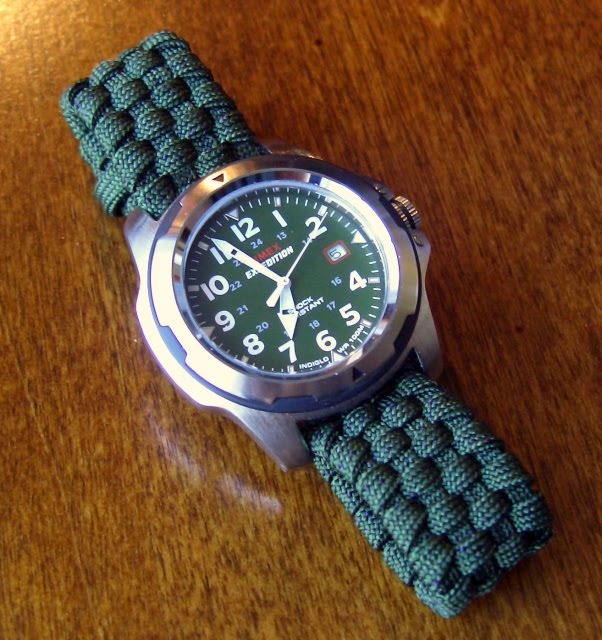
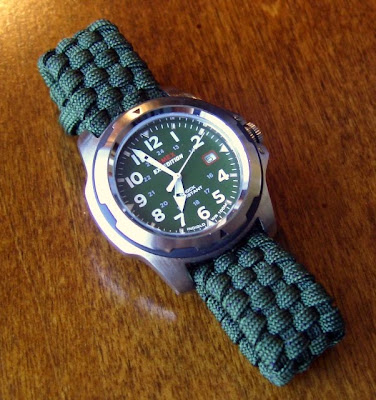
I made this adjustable paracord watchband with the similar weaving method to the paracord pouches/sheaths that I made, with the common basket weaving pattern.

This example is just a rough draft and can use some tweaking to improve it, but I still like the overall outcome.

I took the buckle off an old leather watchband and added four 1 ft long lengths of gutted paracord. I attached the paracord pieces to the buckle, with needle and thread, by sewing the end of each in a small loop around the buckle end.

I used a longer 7 or 8 ft long length of gutted paracord to do the over/under weaving around the four strands. I stopped when I ran out of paracord, then trimmed and tucked the ends. The ends can be sewn in place to further secure them. A short gutted length was used for the tucking band, made by tucking one end into itself and sewn together. It could be sewn in place on the watchband, but I left it free floating to slide where I needed it.


The band is not as long as I'd like it, so I'd use longer lengths of cord for further attempts. I didn't measure out the longer length before I started, so I haven't narrowed down how much is needed for a specific woven length. It's a tight fit for the paracord between the watch and pins. After I made the watchband, I removed the watch pins from the lugs, laid the band over the watch, and reinserted the pins to install the band. The watch stays in place on the band.


I would further secure the cord in the areas where the buckle pin comes through the paracord when sized around the wrist, to keep the cord from being pushed/pulled/stretched out around the pin. I need to get some heavy duty thread or possibly a kevlar sewing thread, which would be stronger and more durable than regular cotton/polyester thread.

My Timex Expedition Field Watch served guinea pig duty for this project, and a Suunto Clipper Compass(luminous/glow-in-the-dark) was also attached to the finished watchband.

And it can be worn alone, as an adjustable paracord bracelet...

A two-toned version, shown with green over tan paracord.

Thursday, April 29, 2010

Chinese lanyard knot...

This is a Chinese lanyard knot, ABoK knot #807, tied with paracord. The knot is also known as the plafond knot.

I followed the directions for tying in my copy of Geoffrey Budworth's 'The Complete Book of Decorative Knots'. You can also find a YouTube video tutorial for the knot from TIAT.

The knot has a flat square shape and the pattern looks the same on the front and back.

The knife shown is a Victorinox Swiss Army Huntsman.

...And a paracord bracelet version with integrated Chinese lanyard knots.

I just looped onto one buckle end, tied 3 spaced out Chinese lanyard knots, looped around other buckle end at wrist size, then tied the cobra stitches/Solomon bar/Portuguese sinnet back towards starting end. Run the cords through the underside of each of the Chinese lanyard knots as you go.

Monday, April 26, 2010

Money clip knots...

I received a nice stainless money clip, from Bill of Crazy4 Money Clips, to try some knot work on.

Using 0.9mm braided nylon mini blind string, I first tried wrapping the cutout sections of the clip with cobra stitch/Solomon bar/Portuguese sinnets.

I also tried a 3 lead 8 bight turks head knot to fit around the clip. I only had white string, but Sharpie markers do an ok job at creating other colors, and I ended up with the red, white, and blue turks head.

I also tried some 'West Country Whipping' on the back section of the clip.

Thursday, April 22, 2010

Celtic button knot....

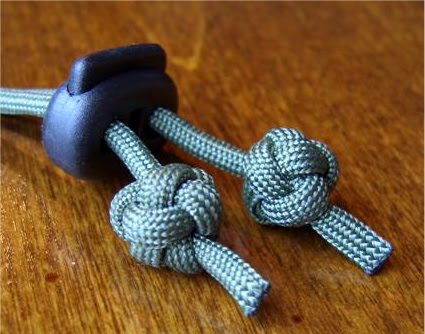
The Celtic button knot looks like the lanyard knot, but is tied with a single working end.  Example shown tied with paracord.

I find them useful as a decorative stopper/terminal knot and finishing the ends of lanyard strands. Here's a short video on tying them, and another link that also shows a sliding version for use with an adjustable necklace/neck lanyard.

Friday, April 16, 2010

Boot knife handle wrap...

I used a single 15 foot length of black 1.4mm braided nylon string to wrap the boot knife handle.

I started with a 3 lead 5 bight turks head knot with three passes. I then ran the cord up to the end of the handle and through the lanyard hole, back down to the turks head knot, where I worked it over/under one of the bights, and then started wrapping the cord around the handle. I went under the cords running up the handle for a turn, then over the cords, alternating the wrap towards the end. I made another 3 lead 5 bight turks head knot over the handle's lanyard hole to finish the wrap.

Wednesday, April 07, 2010

Moku hitching...

I put some Moku hitching(coxcombing) on the top section of this adjustable walking cane. The link shows half Moku hitching, but the instructions do mention how to do the full hitching.

I used two 20 foot lengths of cotton cord for the hitching, for about one foot or so of knotted length on the top curved section of the cane, and a few more feet for each of the 5 lead 4 bight 2 pass turks head knots that were tied over the start and finished ends of the hitching. I had to take a quick glance at my copy of 'Creative Ropecraft' to refresh my memory on the smaller turks head. Even simple knots aren't so simple if you can't remember how to tie them from lack of practice. I also used a few drops of super glue to secure the ends of the cotton cord. The cord came from the fishing tackle section at Walmart.

I could have used more cord to make it longer, but I didn't want to cover the adjustment holes on this particular cane. I've haven't applied anything like varnish to the cotton cord, but that could be done to extend the life of the knotwork and probably protect it from dirt, UV light, and staining over time. Paracord would also work well for this type of knot work, but inexpensive cotton and hemp type twisted lines have a nice look of their own.

Sunday, March 14, 2010

'Rattlesnake Fob' aka ABoK#541...

I made this paracord wrist lanyard by following another video tutorial by JD of TIAT. The 'Rattlesnake Fob', as JD calls it by it's look, is found in the 'Ashley Book of Knots', knot #541-over-and-under heaving line knot.

I started with about 5 feet of paracord, which was plenty long enough to make it work as a wrist lanyard, with a cord lock, and finished with a two strand Matthew Walker knot.

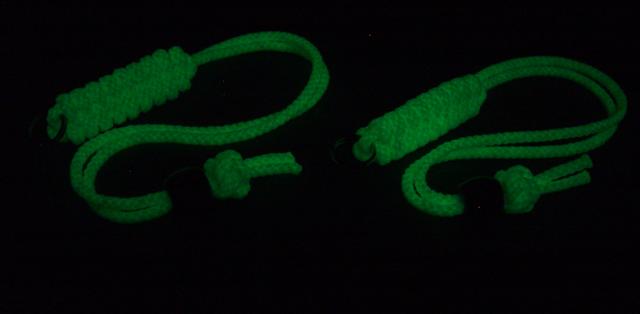
A couple more made with glow-in-the-dark cord, each with a split ring for attachment and a simple wooden bead to slide on the loop for use as a wrist lanyard(I didn't have anymore cord locks).  The lanyard knot at the end of the wrist loop can be tucked up under a belt for retention, with the lanyard hanging down into a pocket attached to a knife, flashlight, key ring, etc...

Saturday, March 13, 2010

Turks Head Water Bottle Sling...

Manny, a fellow knot tying friend out in California, sent me a photo of a turks head knot that he tied, being used as a jug/bottle sling. So I gave it a try.

The knot is a simple 3 Lead 5 Bight turks head knot, tied from a doubled up single strand of paracord. You start from the center, treating the cords as one, making a single pass. When you get back around to the starting bight, you run the paracord ends through the center of the bight you started with. Work the slack out of the knot from the starting point to tighten the knot up around the bottle neck, and when you pull on the end cords, you'll find it does hold on tight.

I haven't yet tested it out over time with use, but it does look like a usable alternative to a regular jug/bottle sling knot. I used a 10 foot length of paracord for enough extra to make an adjustable shoulder strap with the ends knotted together.

*Manny suggested using a cord lock on the strands, slid up against the knot to further secure it.